$64 Million Is Flowing Through NWI and 399 Out of 400 Businesses Aren’t Touching It

Cash Levers
🔲 $64M Available, Almost No One Uses It. Only 0.3% of NWI businesses tapped SBA loans, leaving major funding untouched.
🔲 It’s About ROI, Not Just Rates. Smart owners use 8 to 10% capital to generate 20%+ returns.
🔲 SBA Loans Beat Most Alternatives. Lower payments, longer terms, and fixed rates as low as ~5.7% (504 loans).
🔲 Access Comes Down to Preparation. Basic steps (D-U-N-S, PayDex, vendor credit) can unlock funding in ~90 days.
The Money Cycle Nobody Talks About
Here’s how the machine works. The government collects taxes from you, the taxpayer. It gives that money to the SBA. The SBA runs it through the printer, BRRR, and pushes loans out to small businesses. Those businesses are expected to participate in government-structured programs, donate to non-government organizations, and comply with federal frameworks. Then the government collects taxes from those same businesses. Rinse. Repeat. Cycle continues.
Everyone wins? Maybe. Maybe not. But here’s what’s undeniable: the money is flowing. And if you’re a business owner in Lake County or Porter County, Indiana, and you’re not at least understanding this system, you’re playing the game blindfolded while your competitors are reading the rulebook.
Only 136 out of an estimated 56,000+ small businesses in Northwest Indiana used SBA loans last year.
That’s less than 0.3%. Those 136 businesses captured $64.2 million in FY2024.
The other 399 out of 400? They left money on the table.

The NWI Numbers: $64 Million Flowing and Most Businesses Aren’t Touching It
The best geographic proxy for Lake County and Porter County is Indiana’s 1st Congressional District, which covers all of Lake County, all of Porter County, and a sliver of LaPorte County. Here’s what federal SBA records show:

Lake County ranks among Indiana’s top 5 counties for SBA lending, alongside Marion (Indianapolis), Hamilton, Allen, and Hendricks counties. Centier Bank, a major NW Indiana lender, alone approved 46 SBA 7(a) loans worth $11+ million in FY2025. The average SBA loan size in Indiana over the past decade is $405,123, serious capital, not micro-grants.
Indiana Statewide: Nearly $900 Million Per Year in SBA Capital
Indiana’s SBA lending volume has grown steadily, reaching near-record levels. In FY2025, 1,366 loans pushed $879+ million into Indiana businesses. Over the past decade, Indiana businesses received $4.93 billion in SBA 7(a) disbursements across 12,159 transactions. Indiana’s microloan approvals doubled from FY2023 to FY2024, setting a record since the microloan program launched in 1992.
Small businesses represent 99.4% of all Indiana businesses and employ 43.2% of Indiana’s workforce, about 1.2 million people. This isn’t a niche program. This is the backbone infrastructure of Indiana’s economy.

The Real Interest Rate Picture: It’s More Nuanced Than “Half the Cost”
The prime rate sits at 6.75% as of March 2026, and SBA rates build on top of that. Here’s where you need to think clearly,
SBA 7(a) Loans: What Borrowers Actually Pay
From SBA FOIA data (Q1 FY2026, 10,351 loans): well-qualified borrowers on loans above $350K pay an average of 8.67%. Smaller loans under $50K average 11.06%. The most common rate across all 7(a) loans is 10.0%.
SBA 504 Loans: The Crown Jewel
Current effective rates run 5.62% to 5.92% fixed for 20- and 25-year terms. These are exclusively for owner-occupied commercial real estate and heavy equipment. This is the program that makes the “cheaper than bank money” claim hold up without asterisks.
Traditional Bank Loans
Kansas City Fed survey (Q3 2025): median fixed-rate term loan is 7.22%, variable-rate is 7.75%. Range is typically 5.5% to 11% depending on creditworthiness. Online and alternative lenders charge 15% to 99%+.
The Real Question: Can You Turn 10% Into 20%?
Cost must have a value. So the business owner needs to ask themselves: can I take 10% cost of money and turn it into 20% value?
Because all resources have a value. Money is one such resource. Can I turn that resource into inventory? Can I turn it into foot traffic? Can I turn it into positive cash flow?
If I’m paying 10%, how can I turn it into 20%? That’s the real question.
This is the mindset shift. Most business owners look at the interest rate and think “expense.” The ones who build empires look at the interest rate and think “input cost.” If you borrow at 10% and deploy that capital into a roof restoration that protects $2 million in equipment, or into signage that drives 15% more foot traffic, or into a parking lot that makes your property insurable again, you’re not paying 10%. You’re investing 10% to generate 20%, 30%, 50%.
✉️ Do you know what a full building envelope restoration would cost on your property?
Get the number before you walk into the lender's office.
Subject Property Address: ___________________________
No pressure. No obligation.
[ Email address ] → [ Send Me the Real Stuff ]
Where “About Half the Cost” Actually Holds Up
Scenario 1: SBA 504 vs. Conventional Commercial Real Estate. 504 rates of ~5.7% fixed for 25 years versus conventional CRE at 6.2% to 8.75% with 5–10 year balloons. The 504 loan is cheaper AND eliminates refinancing risk.
Scenario 2: SBA vs. Online/Alternative Lenders. At 8.5% to 10% versus 15% to 99%, SBA loans genuinely cost half or less than what many small business owners actually end up paying when they can’t get bank financing.
Scenario 3: The Monthly Payment Reality. A $500K SBA loan at 8.5% over 25 years costs $4,015/month versus the same amount at 7% over 10 years (conventional) at $5,805/month. That’s a 31% lower monthly payment despite the slightly higher rate, because SBA terms are dramatically longer.
Your neighbor’s SBA loan payment is $1,800/month less than your bank loan, same amount borrowed.
Money Is Like Oxygen: You Need to Know Where to Find It
Money is like oxygen or blood flow, it’s essential for businesses at times, especially if your company is seasonal or if there’s any kind of cycle throughout the year.
So you need to know: where do I access capital? Do I go to hard money? Do I just talk to my banker? Or do I think about government funding? Or am I able to compare these three?
That’s the wisdom. You need to be able to tap into more than just a company credit card. You gotta explore more than the easy road.
Tour all pathways in advance. Become deeply familiar with your options. If for no other reason than to understand how your competitors gain access to capital. You have to know the game. You can’t be in the dark.
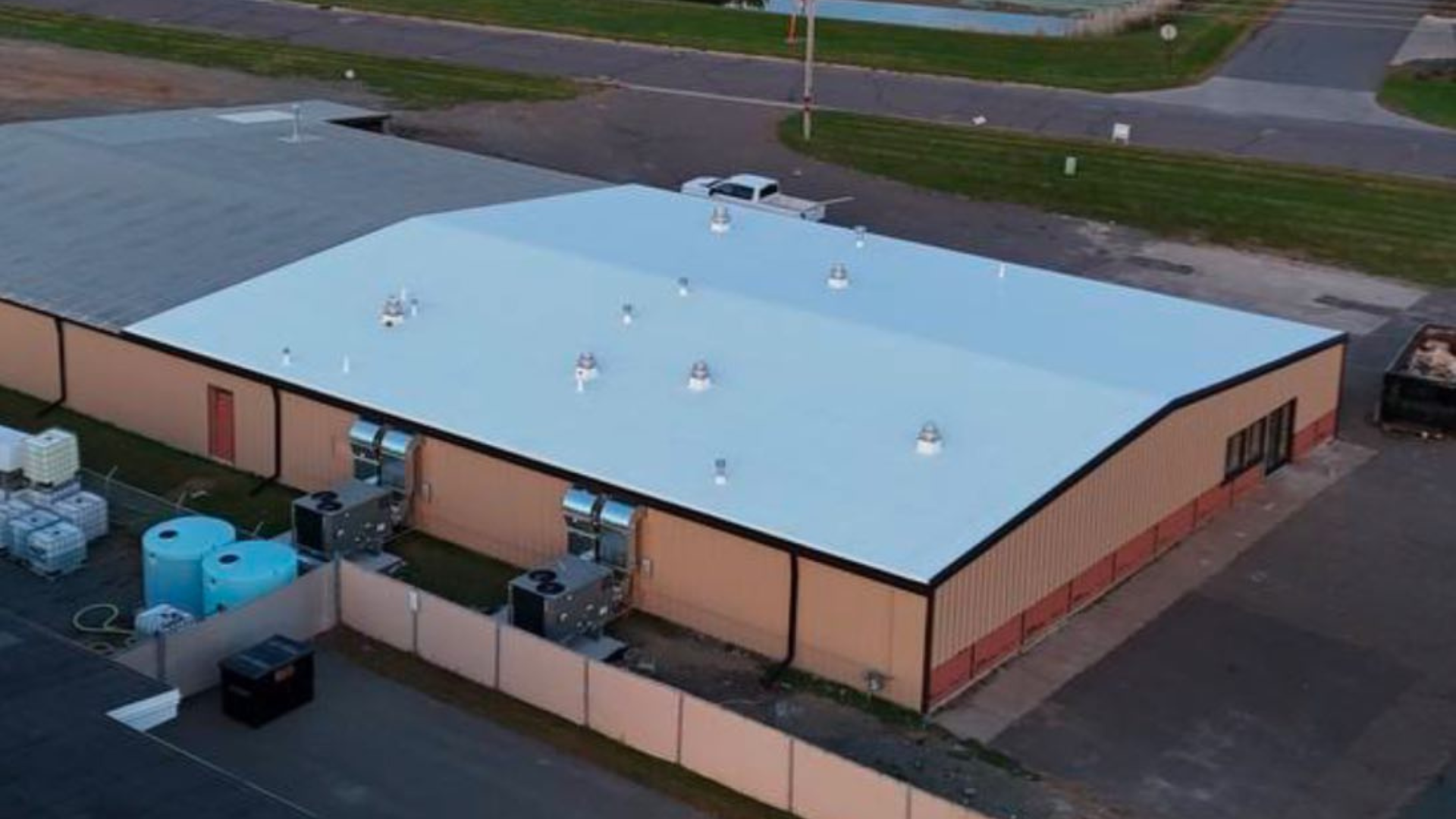
It’s Not Just the Roof: What SBA Capital Can Actually Fund
Here’s what most business owners don’t realize: the SBA loan doesn’t have to go exclusively toward a single line item. If you’re applying for capital to restore your building’s roof and building envelope, you can often bundle related improvements into the same financing package. The roof should represent the lion’s share, roughly 80% of the investment, but the remaining 20% gives you discretion,
- Signage — exterior and interior branding that drives visibility
- Parking lot — resurfacing, striping, ADA compliance
- Landscaping — curb appeal that signals to customers you’re invested in the long haul
- Marketing — the launch campaign to announce your newly improved facility
- Equipment — HVAC, loading dock upgrades, refrigeration, anything tied to the property
Think of it as a building infrastructure refresh, one loan, one application, one monthly payment, covering the full scope of what your property needs to compete. And once you pay it off, you can reapply. This isn’t a one-shot deal.

DUNS and PayDex: The Business Credit Setup Nobody Tells You About
If the SBA loan system is the highway, DUNS and PayDex are your driver’s license. Without them, you’re invisible to the system that’s handing out $64 million a year in NWI alone.
The D-U-N-S Number
A free nine-digit business identifier from Dun & Bradstreet. It takes up to 30 business days to get (or $229 for 5 to 8 day expedited processing). It’s not strictly required for SBA loans, but the SBA strongly recommends it because SBA’s loan processing system is powered by D&B data.
The FICO Small Business Scoring Service (SBSS), which the SBA uses to pre-screen 7(a) applications with a minimum score of 155 out of 300, pulls data from D&B, Experian, and Equifax. No D&B profile means the SBSS score relies entirely on personal credit, which weakens the application.
Much wiser to grow your company score separate from your personal life. You don’t want them intertwined too often.
Important update: as of April 2022, the federal government replaced DUNS with the Unique Entity Identifier (UEI) through SAM.gov for government contracts. But for SBA loans and business credit purposes, the D-U-N-S Number remains the standard.
See… 84% of the crowd had no clue.
The PayDex Score
D&B’s business credit score, ranging from 1 to 100. A score of 80 means you pay on time; 100 means you pay roughly 30 days early. There’s no official minimum PayDex for SBA loans, but lenders generally recommend 80+ alongside a personal FICO of 640+ (700+ preferred for best rates).
Building Your PayDex in 90 Days
- Get your D-U-N-S Number (free at dnb.com)
- Open 2 to 3 net-30 vendor accounts that report to D&B (Uline, Grainger, and Quill are popular choices)
- Pay every invoice early. The PayDex score is dollar-weighted, so early payments on larger invoices carry more weight. Expect 90 to 120 days from setup to having a visible score.
Monitoring costs money: the free D&B tier shows risk alerts but not your actual score number. The basic monitoring plan runs $49/month to see your PayDex. Third-party services like Nav bundle multi-bureau monitoring at lower cost.
SBA Lending Is Booming, But Storm Clouds Are Forming
Nationally, SBA lending is at historic highs. FY2024 delivered 103,000+ financings totaling $56 billion, a 22% increase over FY2023 and 50% over FY2020. The first three quarters of FY2025 produced 85,000 loans and $45 billion in guarantees, a 44.7% increase over the same period in FY2024.
Lending to Black-owned businesses tripled versus FY2020. Lending to Latino-owned and women-owned businesses more than doubled. More than 50% of all 7(a) loans are now under $150,000, meaning the program is increasingly reaching smaller operators.
However, the SBA is simultaneously cutting 43% of its workforce (~2,700 positions) under DOGE-driven restructuring. Lender fees that had been waived were reinstated effective March 27, 2025. The agency is also absorbing the $1.6 to 1.8 trillion federal student loan portfolio, an enormous new responsibility for a shrinking agency. The loan pipeline has remained strong through early 2026, but reinstated fees and tightened underwriting standards could slow growth.
SBA lending just hit an all-time high, but the window may be narrowing. The time to apply is now.

The Courage Gap: Why 399 Out of 400 Never Even Try
A lot of people are like, “Well, my company right now is not cash flowing,” and they think they understand how banks approve and how SBA approves.
But most people just lack the courage to even try. You can see it, one out of 400 even made the effort.
You have to be one of the people that can delegate or grind through it. You kind of owe it to yourself to learn the rules.
You might not get approved this time, but you can’t just fail for lack of attempting.
Ambition is the essence of entrepreneurship. And to say “I don’t need money”, that’s just not having foresight. You might not need money now, but what about Q4? What about the seasonal dip? What about the equipment failure you didn’t see coming?
Planning is the primary responsibility of the executive office. You’re on this throne because your decisions impact many other people.
You’re on this throne because your decisions impact many other people.
Your employees. Your tenants. Your vendors. Your family. They don’t get a vote, but they feel every decision you make, or don’t make. The cost of inaction is invisible right up until it’s catastrophic.
Next Steps: Your 90-Day SBA Readiness Plan
- This week: Apply for your free D-U-N-S Number at dnb.com.
- This month: Open 2 to 3 net-30 vendor accounts (Uline, Grainger, Quill) and pay every invoice early.
- Day 60: Check your PayDex progress through Nav or D&B’s monitoring platform.
- Day 90: Contact an SBA-preferred lender (Centier Bank, Horizon Bank, First Midwest) and begin the 7(a) or 504 application.
- Bonus: While you’re building credit, get a roof inspection. Know the full cost of your building envelope restoration so you’re ready to submit a complete proposal when the financing comes through.
SBA Funding FAQs
How much SBA funding is available to Northwest Indiana businesses?
$64.2 million was approved across 136 businesses in FY2024. Less than 0.3% of NWI small businesses used it. The money is flowing. Most owners just aren't asking for it.
What is the actual interest rate on an SBA loan?
SBA 7(a) loans average 8.67% for well-qualified borrowers on loans above $350K. SBA 504 loans, for owner-occupied real estate and equipment, run 5.62% to 5.92% fixed for up to 25 years. That's the program where "cheaper than bank money" holds without asterisks.
Is an SBA loan worth it if the rate is still close to 10%?
That's the wrong question. The right question is: can you turn 10% cost of capital into 20% return? A roof restoration that protects $2 million in equipment, signage that drives 15% more foot traffic, or a parking lot that makes your property insurable again, that's not a 10% expense. That's a 10% input generating a 20%+ outcome.
What can SBA funds actually be used for?
The roof should represent roughly 80% of the investment. The remaining 20% can cover signage, parking lot resurfacing, landscaping, HVAC upgrades, and marketing. One loan. One application. One monthly payment.
What is a D-U-N-S Number and do I need one?
It's a free nine-digit business identifier from Dun & Bradstreet. Not strictly required for SBA loans, but the SBA's pre-screening system pulls D&B data. No D&B profile means your application leans entirely on personal credit. Get the number first. It's free at dnb.com.
What is a PayDex score and what should mine be?
D&B's business credit score, ranging from 1 to 100. An 80 means you pay on time. Lenders generally want 80+ alongside a personal FICO of 640 or higher. You can build a visible PayDex score in 90 days by opening net-30 vendor accounts and paying early.
How long does it take to get SBA-ready?
90 days for the basics. Week one: apply for your D-U-N-S Number. Month one: open 2 to 3 net-30 vendor accounts. Day 60: check your PayDex progress. Day 90: contact an SBA-preferred lender and begin your application.
Is now a good time to apply for an SBA loan?
Yes, and the window may be narrowing. FY2024 hit record highs with $56 billion in national approvals. But the SBA cut 43% of its workforce in 2025, reinstated lender fees in March 2025, and is absorbing the federal student loan portfolio. The pipeline is still strong. Apply before the tightening hits.
✉️ The Money Is There. The Question Is Whether You'll Use It.
399 out of 400 NWI business owners won't. You're still reading. That's already different.
Subject Property Address: ___________________________
Drop the address. We'll evaluate the roof, give you the full restoration cost, and make sure you walk into that SBA conversation with real numbers.
[ Email address ] → [ Send Me the Real Stuff ]
Pristine Industrial Roofing • Conklin Preferred Contractor • Lake & Porter County, Indiana
We restore commercial flat roofs. We also believe business owners deserve to understand how to fund the work.
CreativeRoofFunding.com | PristineRoofing.com